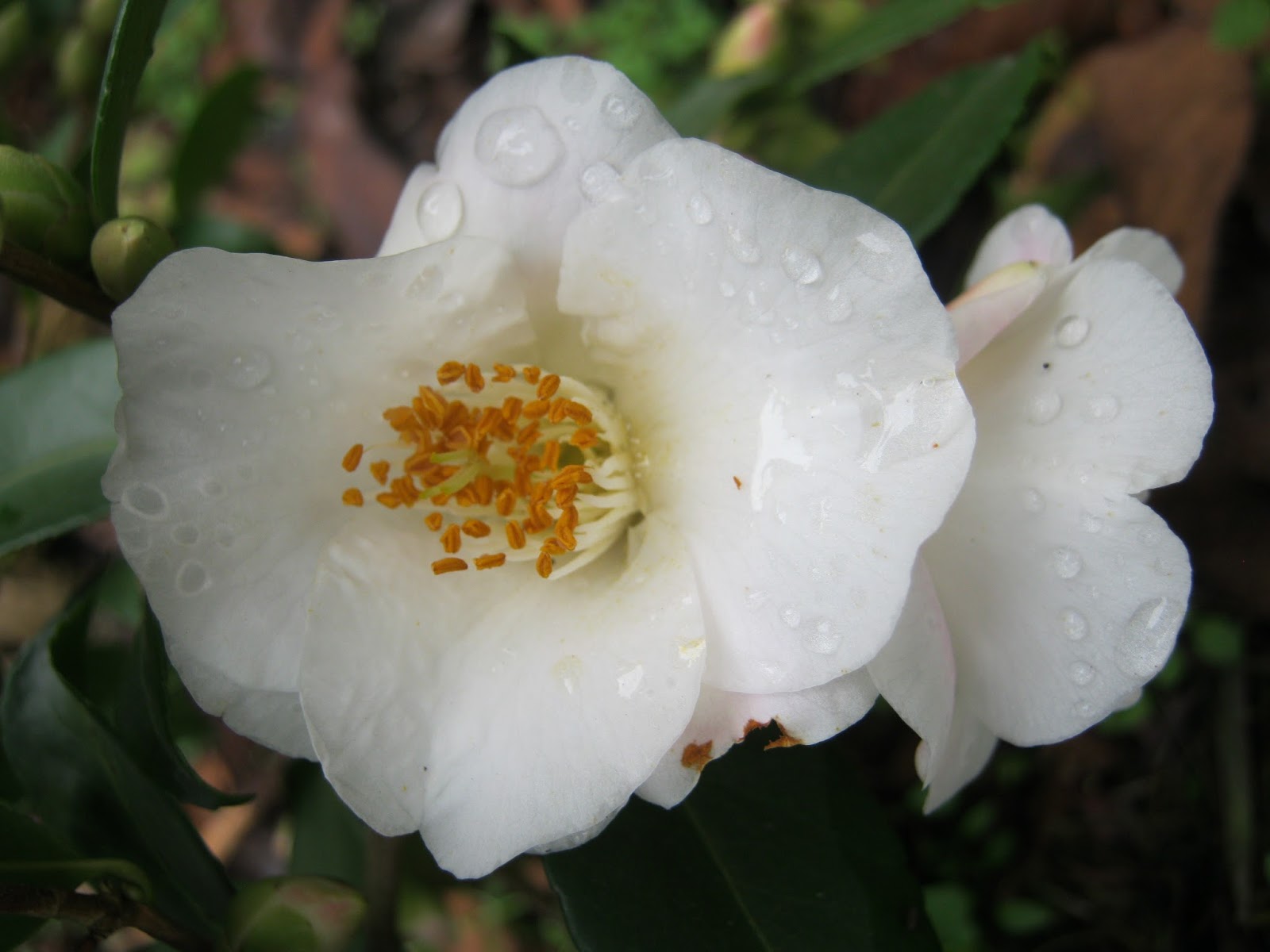
I thought I'd lost my snowflakes, but discovered them yesterday afternoon, doing really well.
Waho: Maori word meaning far out, far flung, far off. Here are bits and pieces from an obscure corner of the world called New Zealand.
Thursday, July 21, 2016
Thursday, July 14, 2016
Garden pics
Pics from today's garden walkies
"Soleil d'Or" jonquils
"Romanesco" broccoli and Wong Bok Chinese cabbage - looking nice and healthy
Kowhai (a New Zealand native tree) just starting to flower
Double primulas
"Quintessence" camellia
The last "Setsugekka" flower until next year
Violets have come out during the last week...
...but is there anything more depressing than old hydrangea heads? I hope to prune these off very soon.
Friday, July 8, 2016
On with the hellebores
Hellebores are starting to come out in the garden. These are wonderful winter flowers, coming at mid-winter and continuing through till late spring. This maroon one is particularly nice.
This hellebore is the one that was in the garden when I came here. Every year I've bought a couple more to add to the collection. My favourite is a freckly pink one, but sadly that doesn't seem to have a flower stalk this year.
The snowflakes are also beginning to come out. These bulbs seem to be incredibly hardy, needing no fertiliser or care. They often pop up in the gardens of abandoned country cottages, blooming away long after the people who planted them have moved on.
The weather here is now quite cold, too cold today to enjoy being outside; a "lazy wind" (so called because it blows straight through you, not going around you) has kept up all day, although the sun was bright. I've spent most of my time watching "Wives and daughters", the BBC adaptation of Mrs Gaskell's novel, and reading a novel called "The summer before the war" by Helen Simonson, who wrote "Major Pettigrew's last stand". "The summer before the war" is a bigger, more serious novel (First World War) but I found it very enjoyable. There are echoes of E.F. Benson, because the novel is set in Rye, where the author grew up. There are a lot of themes in the novel, but they are never hammered hard; the position of women, particularly educated spinsters, the stultifying effects of "society" and "propriety" and of course, the brutality of war.
Back to work tomorrow. Oh God, it's the school holidays. Again.
Thursday, June 23, 2016
Winter solstice madness
Today I didn't really know what to do with myself, so sure enough, I went to a garden centre and bought things. Some women like to go clothes-shopping, and impulse buy stuff they don't really need; I do this with plants. The shop also had a special offer on these coconut bird-feeders. They are filled with a vegetable fat, peanut butter and seed mix that hopefully the birds will find irresistable. Usually bird-feeders like this attract the little wax-eyes. I didn't put one out last winter because of my cat Jiro, who was an enthusiastic bird-hunter and who would have killed many of them. Jiro has since died (sadly) and Thomas is older and wiser, he just likes to look at the birds from the comfort of the conservatory.
I managed to find a treasure at the garden centre, a pale yellow camellia called Nuccio's "Golden Anniversary." This is a japonica camellia synonymous with Camellia dahlohnega.
It looks very pretty and is loaded with buds.
I also bought this hebe "Marilyn Monroe" to put in my front garden to liven up my perennial bed which looks quite dreary at the moment...
.... and this lily called "Pretty Woman"; I like the combination of soft pink and cream.
I am really a mad, extravagant woman! (The manageress at the garden centre knows me quite well now.)
Tuesday, June 21, 2016
1066 and all that: historical novels rule!
My old battered copy. Set in the Late Roman Empire when the Empire was starting to break apart.
Lately, I've taken to reading historical novels again.
My motives are twofold. First, to revisit my girlhood. My mother was a keen devotee of historical novels and passed this liking on to me. Some of the novels we read were factual, others more fanciful.
Before there was ever Hilary Mantel or Phillipa Gregory there was Jean Plaidy, Victoria Holt and Phillipa Carr. Actually these were all the same person, an English writer named Eleanor Hibbert. As Jean Plaidy, she wrote fact-based novels, often about royalty in general and English queens and princesses in particular. As Victoria Holt she wrote what might be called Cornish Victorian Gothic. Many of these had heroines who were governesses or companions or orphans or poor relations in large spooky houses with enigmatic masters/heroes, sort of Jane Eyre-ish. As Phillipa Carr she wrote fictionalised history again, but this time about ordinary women rather than royalty. The "Daughters of England" series took readers through English history using the same family down the centuries.
There were other authors too; Mary Campbell Barnes "My lady of Cleves" and "Brief gaudy hour" and Margaret Irwin's "Young Bess", and of course, Catherine Cookson, though I never really took to her; a bit too much "trouble at' Mill" for me, with their downtrodden characters and grim settings. As a younger child, I'd loved Rosemary Sutcliffe's novels of Dark Age Britain, so Mary Stewart's wonderful series about Merlin and Arthur, which started with "The Crystal Cave" were a continuation of that historical thread, one of those "take me away" books that you live in for a time and feel lost without when you finish.
You can visit so many places and times...Renaissance Venice...
....or Theodora's Constantinople, for example.
And this is the second reason why I have returned to reading historical fiction. With the world in the way it is, it's strangely comforting to reflect that this is the way the world has always been. Other demagogues built walls to keep out barbarians, and the gap between the haves and have-nots was always a gaping one.
Historical fiction is a wonderful time-machine; you can visit the past without having to experience the smells and the filth and the cruelty first-hand, and if you get sick of it, just close the book and you're back in your own house in your own time, with carpet and heating and plumbing and modern medicine. Perfect escapism.
Saturday, June 18, 2016
Camellias
Soon it will be camellia season again. We've already started off with "Yuletide" ...
....and the lovely "Setsugekka", ("Snow flower"). These are both sasanqua camellias, autumn-flowerers with a strange, mossy, patchouli-like scent. The nice thing about these is that the blooms come out before the really cold weather damages them. The sasanquas need sun to flower fully; my "Setsugekka" has been more prolific this year since I removed a shrub that was growing next to it and shading it out. Our climate here in Christchurch is not the best for camellias, it's too extreme; late frosts can brown off the flowers, particularly the whites, into an unsightly mess. A milder, wetter climate would be better for the japonicas.
Later on, we will have japonica and reticulata camellias. "Nicky Crisp" is one of my favourites.
"Barbara Clark" which usually flowers right through from August to November.
"Waterlily" a beautiful formal double
"Nuccio's Gem" - whiter than white.
I have several other camellias in the garden that I don't have pictures of. I've just planted a "Quintessence", a low grower, in the black spot of the front garden, and have another low grower, "Baby Bear" out there too. Camellias are well worth growing in a small garden. They are neat and easily managed and make a quiet background to the showier perennials during summer. There are even yellow camellias, which I do have a hankering for. "Jury's yellow" is a nice one that I covet, but it would have to be in a special spot away from the pinks. Oooo! sudden inspiration! Out the back, by the grey fence. Now all I have to do is shift the agapanthus...
Subscribe to:
Posts (Atom)